
DTS or DTS:X not reaching your sound system through an HDfury Arcana
The disc says DTS-HD Master Audio. The receiver says Dolby Digital, or PCM, or nothing at all. This is one of the most common complaints in eARC setups, and the cause is usually the television rather than the equipment either side of it.
Does this match your symptoms?
- The disc carries DTS-HD Master Audio but the receiver reports Dolby Digital or PCM.
- You get silence on DTS tracks while Dolby tracks play normally.
- Your television has no DTS listed anywhere in its audio specifications.
Fix it in this order
- Set the source to bitstream or passthrough instead of PCM. A source on PCM decodes first and the DTS label is gone before anything else sees it.
- Confirm your sound system decodes DTS at all. Sonos soundbars handle DTS Digital Surround but not DTS:X or DTS-HD Master Audio.
- Route the source through the HDfury Arcana so the audio is taken before the television, which is what removes the most common cause: most televisions do not carry DTS over ARC or eARC.
- Power-cycle the source so it reads the new EDID rather than the cached one.
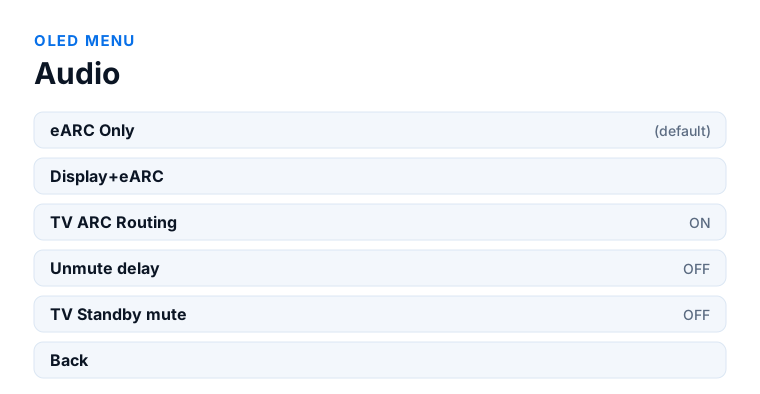
- Only if AutoMix gets it wrong, force an EDID mode over RS232 or the GO2 dongle. There is no EDID entry in the OLED menu.
Which model do you have?
HDfury Arcana (18Gbps). Audio handling is identical on both models. Both extract full audio from the HDMI source before the television sees it, and both pass DTS, DTS:X and DTS-HD Master Audio through untouched. AutoMix mixes the EDID and CDS of both connected sinks.
HDfury Arcana 2 VRR (40Gbps). Identical audio behaviour and the same formats. AutoMix works slightly differently: it mixes the video specification of the TX0 EDID with the CDS or audio specification of the devices at the output ports. The practical result is the same — your source is told what your sound system can decode, not only what your television can.
Most televisions do not pass DTS
This is the part that surprises people. A large number of televisions — including recent, expensive ones — do not carry DTS over their ARC or eARC output at all. Some never licensed it. Others dropped it in a firmware update and did not mention it.
The consequence is specific: if your DTS source runs through the television and comes back out over ARC or eARC, the DTS is gone before it reaches your sound system. The television either converts it to two-channel PCM or outputs silence. No setting on the soundbar can recover it, because the format never arrived.
What eARC itself supports
eARC has ample bandwidth for DTS-HD Master Audio and DTS:X. The standard is not the limitation. What matters is whether every device in the path chose to implement it: the television, the audio system, and any receiver in between.
So there are three questions, in this order: does the source output DTS, does the path carry it, and does the sound system decode it?
Check the source first
Set the source to bitstream or automatic passthrough rather than PCM. A source set to PCM decodes the audio itself and sends uncompressed stereo or multichannel, which means the DTS label disappears before anything else in the chain sees it. This is the single most common cause and the quickest to rule out.
On disc players, check the audio output menu for a setting like “Bitstream”, “Passthrough” or “Auto”. On streaming boxes, look for a setting that allows the original audio format to pass unchanged.
Where the HDfury Arcana changes the outcome
The Arcana takes the audio directly from the source, before the television has any say in it, and sends it to the audio system over its own eARC output. The television is no longer in the audio path at all.
That removes the most common cause outright. If your DTS was disappearing because the television refused to carry it, routing the source through an Arcana solves it — and this is exactly why the DTS complaint comes up so often in discussions about these devices.
It does not, however, create support that does not exist. If the soundbar or receiver cannot decode DTS, nothing upstream can help. Check your audio system's specification sheet before assuming the fault is elsewhere.
A note on Sonos
Sonos soundbars support DTS Digital Surround on current models, but not the lossless DTS-HD Master Audio or DTS:X variants. If your source is sending DTS-HD MA, the practical outcome is the core DTS track rather than the lossless one.
That is a limitation of the audio system, not of the connection, and it applies whether or not an HDfury Arcana is in the chain. It is worth knowing before you spend time diagnosing something that is working as designed.
EDID and format negotiation
The HDfury Arcana advertises an EDID to the source that describes what the audio system can handle. If that EDID is built from the television's capabilities rather than the audio system's, and the television does not list DTS, the source will not send DTS.
By default the Arcana handles this with AutoMix, building a custom EDID from what the connected devices report — which normally means the audio system's DTS support is already advertised. Modes such as TV only, eARC only or TV+eARC can be forced if AutoMix gets it wrong, but the manual is specific that this runs over RS232 rather than the OLED menu. Power-cycle the source after any EDID change, because sources cache it and will otherwise keep using the old one.
Frequently asked
What should I do if I have an HDfury Arcana (18Gbps)?
Audio handling is identical on both models. Both extract full audio from the HDMI source before the television sees it, and both pass DTS, DTS:X and DTS-HD Master Audio through untouched. AutoMix mixes the EDID and CDS of both connected sinks.
What should I do if I have an HDfury Arcana 2 VRR (40Gbps)?
Identical audio behaviour and the same formats. AutoMix works slightly differently: it mixes the video specification of the TX0 EDID with the CDS or audio specification of the devices at the output ports. The practical result is the same — your source is told what your sound system can decode, not only what your television can.
Why does my TV not pass DTS to my soundbar?
Many televisions never implemented DTS over ARC or eARC, and some removed it in a firmware update. The television converts the audio to PCM or outputs nothing, and no setting downstream can recover the original format.
Does eARC support DTS-HD Master Audio?
Yes, eARC has more than enough bandwidth for DTS-HD Master Audio and DTS:X. Whether you get it depends on the television, the audio system and any receiver in the path, not on the standard.
Does the HDfury Arcana let my Sonos Arc play DTS:X?
No. The Arcana can deliver whatever the source sends, but Sonos soundbars do not decode DTS:X or DTS-HD Master Audio. Current models handle DTS Digital Surround.
My source is set to PCM. Does that matter?
Yes, quite a lot. A source set to PCM decodes the audio itself, so the DTS format is gone before the signal leaves the source. Set it to bitstream or automatic passthrough.
Related
- No Dolby Atmos on Sonos Arc or Beam Gen 2
- eARC not working or falling back to ARC
- Which model handles which audio formats
Does an HDfury Arcana or HDfury Arcana 2 solve this?
Both models handle the same audio formats. The choice between them is about video: 4K60 for the Arcana, 4K120 and VRR for the Arcana 2.
Checked against the official HDfury Arcana and HDfury Arcana 2 manuals and against firmware 0.88 and 0.25, August 2026.